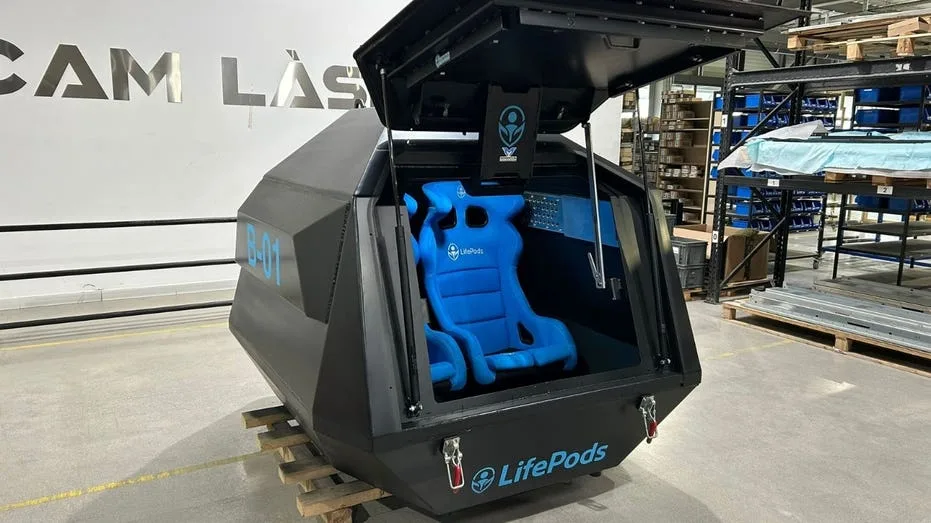
Emergency preparedness traditionally involves basic supplies such as bottled water, flashlights, and possibly a home generator. However, a French startup is elevating this concept with its innovative LifePods survival capsules. Momentum Technologies recently showcased these capsules, which, according to the company, are engineered to safeguard individuals, families, emergency responders, and vital infrastructure during natural catastrophes, industrial incidents, and security risks.
The timing for such a product is particularly pertinent given the increasing frequency of power outages, rapid onset of floods, and global instabilities that lead many to question their readiness should immediate assistance be unavailable. LifePods aim to transform these anxieties into a tangible product that can be acquired, positioned, and deployed proactively before a crisis unfolds.
Specialized Designs for Diverse Threats
LifePods survival capsules are compact, robust shelters crafted for extreme emergency scenarios. Momentum Technologies asserts that these capsules can offer immediate refuge during tsunamis, flash floods, storm surges, armed assaults, structural collapses, intense fires, and hazardous environments. This differentiates them from conventional underground bunkers, as LifePods prioritize rapid deployment and a smaller physical footprint.
The company currently features two primary commercial models. The W-01 is a floating capsule specifically designed for water-related disasters, while the B-01 is an armored land capsule built for ballistic and industrial protection. Momentum also has a conceptual Q-01 model focused on earthquake protection under development.
The LifePods B-01 presents as the more rugged option, conceived for hostile environments, critical infrastructure, and situations demanding swift shelter. Momentum states the B-01 offers occupants protected space against ballistic threats, fragments, armed attacks, and degraded environments, emphasizing that individuals can enter and secure the system within seconds.
This model appears to target security teams, industrial facilities, and public safety organizations more than private citizens. Momentum suggests potential applications at military or police checkpoints, energy production sites, telecommunications hubs, transportation terminals, and heavy industrial locations.
The B-01 specifications include capacity for one to two people, high-hardness ballistic steel, optional positive air filtration, and an approximate weight of 4,000 pounds. Momentum indicates that representative test panels have achieved VPAM PM7 certification for resistance to 7.62x51mm military ammunition, a common .30-caliber rifle round. Civil validation under SR7 is still in progress.
The LifePods W-01 is the model likely to resonate more with individuals residing near bodies of water. Momentum describes it as a floating capsule for extreme weather conditions when safe evacuation is no longer possible.
The company states that the W-01 addresses risks associated with tsunamis, hurricanes, floods, marine submersion, and dike or dam failures. It is engineered to float, withstand impacts, and keep occupants safe until rescue teams arrive. Momentum reports the W-01 is designed to comfortably accommodate four adults, with provisions for young children using additional restraint systems similar to those in commercial aviation. Exterior grab bars are also integrated, allowing survivors already in the water to hold onto the capsule while awaiting rescue. Each W-01 is equipped with a geolocation and emergency distress transmission system, aiming to expedite the location and rescue process by emergency services.
The W-01 is currently in its final engineering development phase. Momentum confirms that its structural performance has been simulated using advanced naval engineering software by Inha Works Ltd. (IWL), a Yamaha Motor Group subsidiary. This modeling has allowed for the evaluation of structural resistance, buoyancy, and stability prior to physical testing. Physical validation is anticipated to commence in the latter half of 2026, encompassing initial flotation and stability tests, real-world sea trials, and final certification testing in a specialized laboratory capable of replicating extreme disaster conditions like wave impacts.
Momentum's conceptual Q-01