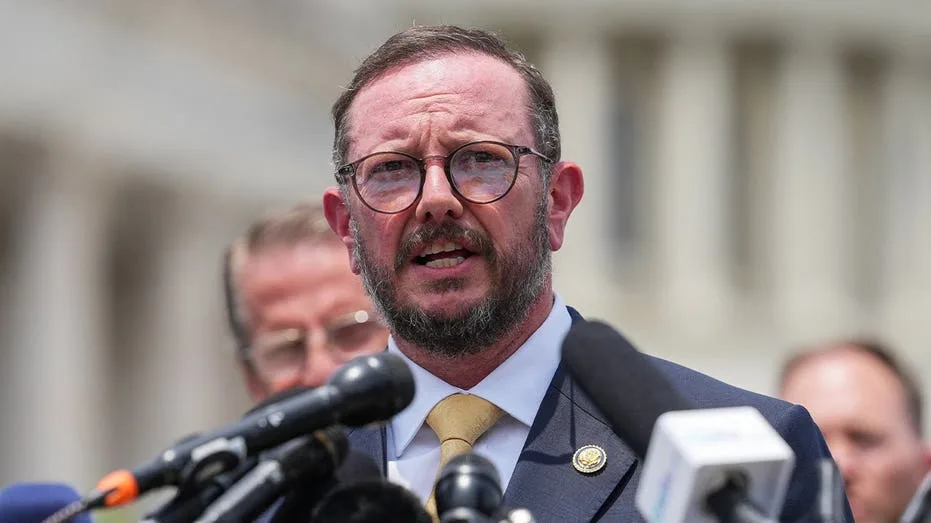
Missouri Representative Eric Burlison has voiced strong criticism against his congressional peers, asserting that many lawmakers, spanning both political parties, exhibit an excessive propensity for spending, which he believes burdens working-class families amidst a national debt exceeding $40 trillion.
“Most of my colleagues like to spend money…they like to spend other people's money. They're drunk on spending other people's money, even Republicans, unfortunately, and there's few people up here like myself who were willing to make significant spending reductions,” Burlison stated.
He recounted the arduous struggle to implement any spending cuts within a major legislative package, facing opposition not only from the left but also from members within his own party. Burlison warned that this spending spree is unsustainable.
“At some point, the party is going to be over, and we are all gonna wake up in a drunken stupor with a hangover, and it's going to be painful, and we're going to have to figure out how to get our way out of that,” he cautioned. “All of these sins of overspending are haunting us. And now we're seeing…inflation that we can't control. We're seeing the interest rates go through the roof. At some point, you can't keep borrowing money…Sadly, my colleagues that weren't willing to cut spending are going to be forced to cut spending.”
Fiscal Discipline Urged Amid Soaring National Debt
Despite the Republican Party's efforts to position itself as the champion of affordability, Burlison suggested a significant communication challenge as the country approaches upcoming elections. He emphasized the urgency of addressing fiscal irresponsibility, pointing to the current economic climate marked by unchecked inflation and rising interest rates as direct consequences of prolonged overspending.
The Healthcare Affordability Crisis
Burlison specifically identified healthcare as a primary driver of financial strain for American families.
“It's really sad. This office has been broadcasting to the leadership every chance that we can that the American people are feeling the crunch, they're feeling the affordability crunch,” he explained. “We put together a solution that we call the Great American healthcare plan. We also have another bill that addresses the housing affordability issue.”
He expressed frustration that despite his office advocating for these solutions to leadership for at least two years, there has been a reluctance to tackle these complex issues. According to Burlison, Washington D.C. often shies away from difficult tasks, and reforming healthcare should be the paramount focus.
He underscored how escalating healthcare costs are depleting household discretionary income. In 2000, the average American family of four paid approximately $6,000 annually for health insurance premiums. Today, that figure has surged to $27,000 per year. Had these costs merely kept pace with standard inflation, they would only be around $11,000 annually.
“If you ask the average family of four, would you like to be paying health insurance premiums at $11,000 a year, they would say, heck, yeah, that sounds like a great deal. That is not what they're paying today. They're paying $27,000,” Burlison highlighted. “So if you think about that, just that alone, that is crowding out everything else that the average American family has to pay. You have to come up with another $16,000 that you didn't have to come up with before, in order to pay for a healthcare system that has exceeded inflation by three-fold.”
This three-fold increase in health insurance premiums above normal inflation is, in his view, unsustainable and forces families to make tough choices. He attributes this crisis to factors like young people struggling to afford homes, reduced leisure spending, and fewer vacations, indicating a significant shift from the financial landscape of two decades ago.
Internal Party Struggles and a Call for Republican Vision
Recalling a period of significant public interest in certain digital currencies in early 2025, Burlison noted an ironic disconnect between the enthusiasm shown by some congressional members and their actual voting records on fiscal matters.
“DOGE was the most exciting thing I've ever seen in politics. And I was super excited about it. But I also was skeptical. I watched Elon come give speeches to my colleagues,” he recounted. “And what was ironic is that some of the most swampy members of Congress were rushing to the microphones to embrace Elon to talk to him to tell him where he should go to look for spending reductions. And yet those very people were the ones that were voting against every spending reduction that you would ever bring to the floor.”
He lamented the missed opportunities, citing hundreds of proposed amendments to appropriations committees aimed at cutting spending, which consistently failed to pass. Burlison believes the Republican Party must undertake introspection.
“All we have to do as Republicans is look in the mirror and say where's the problem? It's me, it's us,” he asserted. “I'm one of these almost going extinct members of the Republican Party that still believes in fiscal prudence, still believes and in cutting spendings this small government free market conservative. But unfortunately, that's not how all of my colleagues feel.”
He urged his colleagues to articulate a clear economic vision for the American public, particularly concerning the healthcare system.
“In my opinion, it's not enough to run against a platform. If you have to provide a vision to the American people, and if you ask the American voter today, what will the Republican Party do if they're reelected…I don't think that they would know,” Burlison commented. “And so to me, the vision that I would provide is to say, 'we're going to fix healthcare. We're going to make healthcare affordable. We're gonna to make it a free market. The prices are going to be transparent, and you're going to know exactly what you're buying'.”
Addressing Fuel Costs During Conflict
In addition to broader fiscal concerns, Burlison proposed a specific measure to alleviate financial pressure at the gas pump, especially in light of ongoing international conflicts.
“Conservatives, we love cutting taxes and I think that we should be cutting the fuel taxes during this period of time,” he suggested. “I would love to eliminate the taxes altogether, but at least it would make sense that during this conflict that we should cut taxes on both gas and diesel until this war is resolved.”
He estimated that such a cut could significantly benefit consumers, noting that for diesel, it would translate to a reduction of approximately 40 cents per gallon.