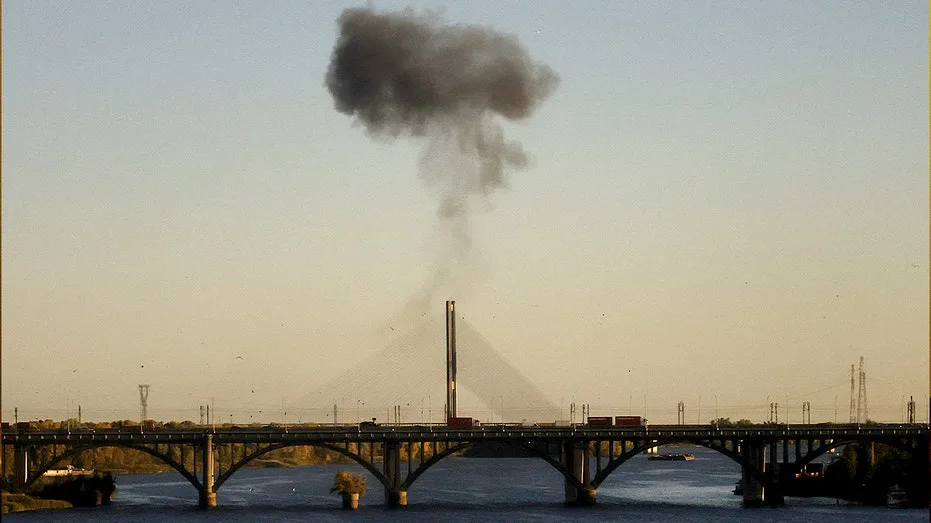
Russia may be employing small, concealed ground-based devices, often referred to as repeaters, to enhance the effectiveness of its drone operations against Ukrainian defenses. Cameron Chell, CEO and co-founder of Draganfly, a drone technology company, suggests these devices are integral to an expanding "mesh" network. This advanced system allows Russian unmanned aerial vehicles (UAVs) to transmit encrypted signals across multiple connections, significantly complicating Ukrainian efforts to jam and neutralize them through conventional electronic warfare.
Chell's observations coincide with escalating diplomatic tensions in the region. Moscow recently issued urgent advisories on October 3, recommending that foreign nationals and embassy personnel immediately depart the Ukrainian capital, Kyiv, citing "mortal danger" and threatening further "massive retaliatory strikes" from Russian forces.
According to Chell, Russia has come to a pivotal realization that innovation will be the deciding factor in the conflict. He remarked, "Russia has come to the realization that innovation is going to have to win this war, to the point now where they are becoming the innovative leader in this war—not just in terms of tactics, strategy, and technology, but the entire mindset is shifting."
The Rise of Mesh Networks in Drone Warfare
Mesh networks operate by enabling drones and strategically positioned ground-based repeaters to relay encrypted signals via numerous connections. This architecture makes it considerably more difficult to disrupt many Russian drone flights.
"The use of mesh networking is now making it increasingly hard for a defensive position to bring down Russian drones in an effective manner," Chell explained.
"With real-time precision, Russia can also now take their drone device into a particular window," Chell further cautioned. "You can take the device onto a particular portion of a bridge because you can make that real-time, last-minute decision live because you've got all these additional network connections that increase not just your bandwidth, but also your resilience in terms of being jammed."
This rapid technological advancement on the battlefield by Moscow aligns with notably precise attacks on critical infrastructure within Kyiv, including key river crossings.
On September 29, Ukrainian Air Force spokesperson Yurii Ihnat confirmed that Russian forces are integrating mesh networking into their drone fleets, alongside upgrades to onboard optical systems. "The enemy is using high-quality materials in its UAVs and increasing camera resolution, allowing the enemy to view the situation on the ground in detail and use these UAVs for various targets. And the use of mesh networks is indeed present. Of course, this is quite dangerous," Ihnat stated, as reported.
Chell highlighted the strategic intent behind this development: "They are using the principles of mesh networking to combat the counter-drone measures taken by Ukraine to ensure that drones can't get through or that those Russian communication links are broken." He elaborated on the challenge this presents: "If Russia had multiple nodes that could communicate with a device and could use the device to communicate with other devices swarming the area, Ukraine would be faced with multiple, maybe even hundreds of connections to have to break simultaneously in order to bring that drone down."
Hidden Repeaters: A New Electronic Warfare Challenge
Adding to these concerns, Serhii Beskrestnov, a defense technology adviser to the Ukrainian presidency, warned on October 3 that Russian forces might have concealed these small signal boosters, or ground repeaters, within Kyiv itself to extend drone control capabilities.
"Such repeaters are difficult to find, but we must search for them. As long as they exist, shielding the city with electronic warfare will not be effective," Beskrestnov cautioned.
These repeaters are specifically designed as small, covert radio relay devices. Their function is to receive and retransmit signals, thereby expanding the operational range of drone operators and helping to sustain control in areas where direct communications or GPS signals might otherwise be compromised.
"The size of these repeaters is really about the size of a large lunchbox. They're very easy to conceal, and they don't have to be turned on all the time, so they're hard to detect electronically," Chell explained.
"Moving one or two or even three of these into a city the size of Kyiv can be hugely effective," he added.
Technical analysts have cited a September 4 strike on the Security Service of Ukraine (SBU) headquarters on Volodymyrska Street in central Kyiv as early potential evidence of this tactic. Tracking data from the incident reportedly indicated no relay drones were airborne during the attack, which fueled speculation that concealed ground-based repeaters might have been instrumental in maintaining communication with the attacking drone.
"They will be doing everything they can to move as many of these things not just into Kyiv, but at any location in the country, even operational battlefields," Chell predicted. "The reality is every time you put another node on a mesh network, you exponentially increase the efficiency, resiliency, and capability of that network."
Ukraine's Defense Challenges and Future Outlook
Ukrainian President Volodymyr Zelenskyy reported on September 28 that while Ukraine typically intercepts approximately 70% of conventional Russian drones during extensive attacks, this interception rate drops to 57% when confronting newer, faster jet-powered UAVs.
"It is obvious that the Russians are not preparing to stop the war – at least not at the moment," Zelenskyy stated.
He further indicated, "Next year Russia plans to spend US$12 billion just on producing jet-powered drones and loitering munitions. And that's only one category of weapons. Of course, this doesn't only relate to Ukraine," according to reports. This suggests a broader strategic intent beyond the current conflict.
"Russia probably has the intention of, if needed, expanding this war," Chell warned, emphasizing that the drones themselves are becoming secondary to the sophisticated communications infrastructure guiding them. "The network is now the weapon, and the drone is what executes the desired result," he concluded, calling this an "unbelievable moment in the tactics of what's unfolding here with the future of warfare."