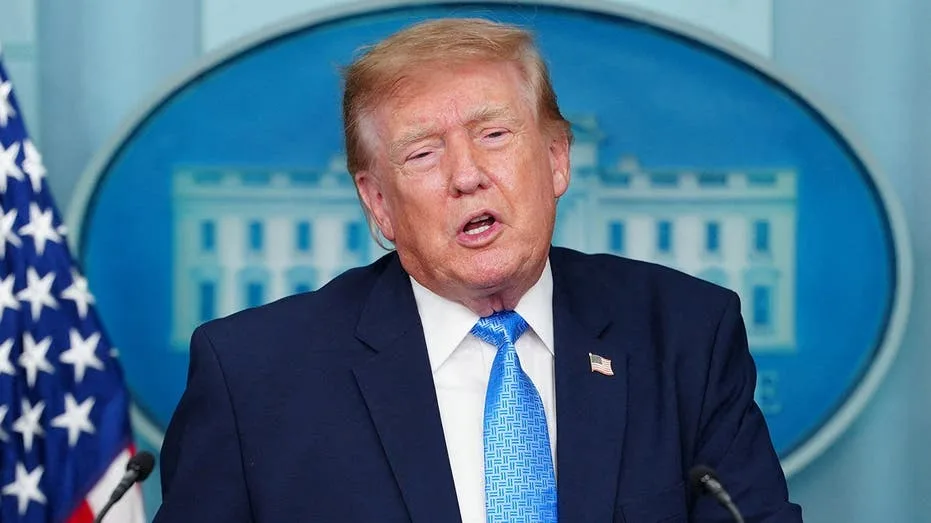
Former President Donald Trump stated Monday evening that his administration's immigration enforcement strategy did not apply the same level of pressure to migrant laborers as it did to individuals he characterized as murderers and drug traffickers.
During a telephone conversation with C-SPAN, Trump was questioned on whether individuals who abide by laws, pay taxes, and have resided in the U.S. for extended periods should face deportation alongside migrants implicated in severe offenses.
"We certainly haven't put the same push on them as we have on the murderers or the drug dealers," Trump remarked.
He further elaborated, "Frankly, a big problem we had is the mental institutions being dumped into our country. Some very dangerous people were released into our country, to put it mildly. So we have not put the same pressure, obviously. And, you know, we call them the worst of the worst. We haven't put the same pressure on waitresses and on farm workers, etc. Not even close."
Immigration Stance and Post-Midterm Reflections
These comments follow Trump's earlier suggestion of collaborating with Democrats on an agreement for certain immigrants who have lived in the U.S. unlawfully for over a decade. This idea emerged after Republicans lost majorities in both chambers of Congress in the recent midterm elections.
In a "60 Minutes" interview broadcast on Sunday, host Ross Douthat inquired whether Trump was open to bipartisan immigration discussions as he approached the conclusion of his presidential term.
"I'd love to do something on immigration," the president responded.
When asked if immigration enforcement policies had negatively impacted Republicans in the midterms, Trump suggested it had both beneficial and detrimental effects. He commended his administration's border security measures while acknowledging criticism regarding the deportation of individuals who held employment.
"But I get hurt because we also took people that had good jobs," Trump noted.
Trump observed that some Americans advocate for the deportation of all immigrants who entered the country illegally, while others believe long-term workers, especially those in landscaping or hotel industries who pay taxes, should be permitted to remain.
"When you go into a hotel and you have a woman that's working there as a maid, as a cleaner as a this as a that, as a waitress, a lot of good things, great jobs, and all of a sudden they're being taken out of the country, it's tough. It's a tough thing," Trump stated, adding that some on the far-right support deportations irrespective of whether the undocumented immigrant is employed.
During the interview, Trump indicated a willingness to "work a deal" for individuals who had been in the U.S. without authorization for "10 and 15 years."
However, earlier on Monday, at a White House press briefing, Trump asserted that "there won’t be amnesty" and that his policy "hasn’t changed."
Other Policy Discussions: Impeachment and Iran
In the same C-SPAN phone call, the president was asked about the potential impeachment of Pentagon chief Pete Hegseth and whether he anticipated Republican opposition to it.
The House of Representatives could consider Representative Thomas Massie's, R-Ky., impeachment resolution against Hegseth as early as Tuesday. Asked for his reaction if some Republicans were to vote in favor of Hegseth's impeachment, Trump expressed that he would be "disappointed."
Trump also responded with "it depends" when asked about the timeline for the conflict with Iran to conclude.
"Maybe we could knock it out fast or we could knock it out over a short, not a long period of time," he said.
He continued, "Now it's a question of I could do it quickly or not. The reason I'm doing it this way is because in speaking with Qatar, as you know, the Prime Minister was in the Oval Office today, in speaking to Saudi Arabia, UAE, Bahrain, Kuwait, basically the neighbors who were attacked pretty violently, by the way. But in speaking to them, they'd rather do it this way rather than another hit, which would be approximately five times bigger than the first hit, which basically decimated them. So, I'd like to do it this way, too."
Trump concluded by stating his belief that Iran "would like to make a deal, and we'll find out whether or not that'll happen."