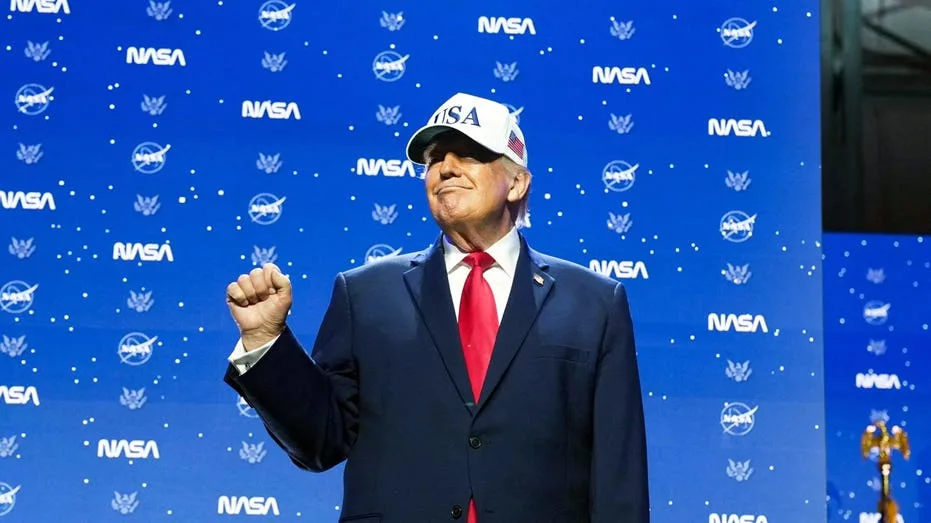
From the Kennedy Space Center in Cape Canaveral, Florida, former President Donald Trump recently underscored NASA's intention to deploy its inaugural nuclear-powered spacecraft to Mars within the next two years. This initiative, he stated, forms a crucial part of his administration's broader strategy to advance American space exploration and ultimately send human crews to the Red Planet.
Addressing attendees at the UP Summit, Trump declared, "Within the next two years, NASA will launch the first ever nuclear-powered spacecraft to Mars." He characterized this mission as a foundational step toward achieving the long-term objective of human interplanetary travel. "We're going to be paving the way for astronauts to plant the Stars and Stripes on the Red planet," he added, envisioning a future where American explorers reach Mars.
Advancing Lunar and Martian Exploration
This upcoming Mars mission aligns with NASA's ongoing Artemis program, which is designed to establish a sustainable human presence on the Moon as a precursor to crewed missions to Mars. The Artemis II mission recently completed a successful lunar flyby earlier this year, marking a significant milestone. Looking ahead, Artemis III is slated for 2027 to conduct in-Earth-orbit tests of spacecraft and landing systems. Subsequently, Artemis IV aims for a lunar landing in early 2028, coinciding with the potential conclusion of Trump's presidential term.
Establishing a Lasting Presence Beyond Earth
Beyond the Mars initiative, Trump detailed his administration's broader strategy to accelerate space exploration, emphasizing the goal for the United States to "establish a permanent presence on lunar soil." He also referenced his recently promulgated "American Declaration of Freedom in Space," a document affirming the rights of Americans to explore and settle areas beyond Earth's atmosphere under U.S. jurisdiction. "Just this week, I issued the American Declaration of Freedom in Space, proclaiming all of space opened for American settlement, American civilization, and American freedom," he stated.
Prior to Trump's address, NASA Administrator Jared Isaacman spoke about the agency's long-term aspirations, including its focus on Mars. Isaacman remarked, "We are going to venture farther into the solar system and move closer to that next giant leap." He articulated the administration's ultimate vision as the moment "American astronauts plant the Stars and Stripes on Mars."
The administration's comprehensive space agenda has also included proposals for a U.S. Space Academy, an initiative announced by Trump in August. This proposed institution would be dedicated to training individuals for roles within the Space Force, NASA, and the commercial space sector. Trump concluded by articulating his overarching philosophy for American engagement in space: "Our calling is to explore. Our purpose is to build, and our aim is always to win."