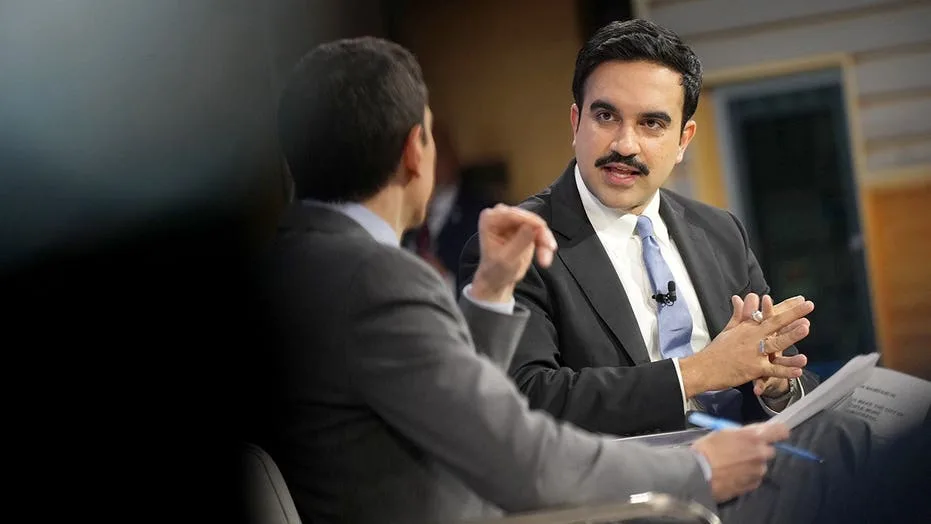
New York City Mayor Zohran Mamdani recently faced intense questioning regarding his administration's efforts to address antisemitism during an appearance at The New York Times DealBook Summit. Following an initial greeting to his "comrades," Mamdani was immediately pressed by Andrew Ross Sorkin of The New York Times on the critical importance of "language," particularly concerning New York City's Jewish community and the observable rise in antisemitic incidents.
Scrutiny Over October 7 Statement
Sorkin highlighted a controversial social media post by Mamdani, published after the October 7 terrorist attacks in Israel. The post, Sorkin noted, dedicated more attention to the struggles of Palestinians and Israel's military actions in Gaza than to the approximately 1,200 Israelis brutally killed by Hamas on that day.
The head of the Reform Jewish movement has said at the time that they thought that the statement made New Yorkers less safe. And then there was a rabbi who said — they called himself a fan of yours — he said, 'Can we just have one day?' And I'm curious, again, about the language you use. And the reason I mention it is, you know, 53% I think of hate crimes in New York City are against Jews. And so, when you use language in this regard, and I know we can have a whole debate about whether condemning Israel gets conflated with antisemitism and this and that, but do you feel like there's an extra sort of responsibility or distinction in the language you use when you use it?
Sorkin's questioning underscored the gravity of the situation by pointing out that over half of hate crimes in New York City are directed against Jews, leading him to ask Mamdani about his responsibility in choosing his words.
Mayor Mamdani's Defense and Universalist Stance
Mayor Mamdani challenged the underlying premise of Sorkin's inquiry, asserting that his social media post did not encapsulate his full engagement during that period. He mentioned attending a vigil honoring the October 7 victims, an action for which he also faced protests.
Mamdani articulated his political philosophy, stating, "My politics is one that believes that there has to be room to mourn everyone." He elaborated that his intent, both in his public statement and his physical presence at the vigil, was "to make clear that I will oppose with every bone in my body the violations of international law no matter who commits them, who conducts them." He explicitly labeled October 7 a "war crime" and affirmed his consistent criticism of the Israeli government.
The democratic socialist mayor expressed his strong disapproval of the statistic indicating that Jewish New Yorkers constitute over half of all hate crime victims in the city, despite making up only 10-12% of the population. "That, to me, is unacceptable," Mamdani declared. He added, "I'm also proud to be the mayor of the most Jewish city in the United States of America. So much of what so many of us love about New York is tied up in that same legacy."
He stressed that his responsibility involves "root[ing] out antisemitism, you have to root out any form of bigotry." Mamdani acknowledged that many Jewish New Yorkers, alongside others, hold differing views on Israel and Palestine. Nevertheless, he maintained, "My job is to still deliver for them as well, and to deliver them the best possible city, because, at the end of the day, they live in the same city."
The Intertwined Nature of Events
Sorkin then posed a direct follow-up question, which was met with audience applause:
My question is, would you ever think about sending out one tweet on Oct. 7, saying how terrible what happened on Oct. 7 was, and then waiting till Oct. 8 to say how terrible you think Israel has handled the situation?
In response, Mamdani explained his integrated approach, arguing that "When the Israeli government is conducting a genocide of Palestinians, oftentimes the defense that will be given, no matter what day that it's asked about, will be the relationship to Oct. 7." He further clarified, "My point being, this is a day that is not only a horrific war crime, it is also a day that has been used as a justification for all that followed it. And it is in that day that it is important, like in any day, to mourn the totality of its impact."
While insisting he comprehends "the other side" of the argument, Mayor Mamdani reaffirmed his position. "I have a politics of universality," he concluded. "Whenever I'm asked about 'Why do you support Palestinian freedom or Palestinian rights?' I speak about the importance of extending these same values, of empathy. And that is who I am."